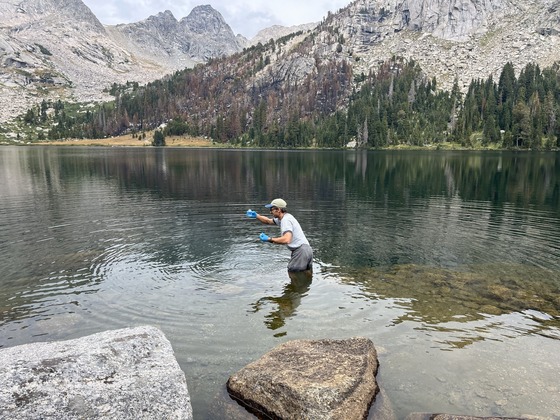
Statewide, Wyo – The Wyoming Department of Environmental Quality (WDEQ) Water Quality Division (WQD), in collaboration with the Shoshone National Forest (SNF), completed an evaluation of Lonesome Lake and Big Sandy Lake, indicating that Escherichia coli (E. coli) samples collected in the summer of 2025 attained state water quality standards for recreational uses.
WDEQ and SNF initiated a study of the two popular Wind River Range wilderness lakes following a 2022 sample from a national study that showed elevated levels of enterococci, a fecal bacteria indicator. The study team launched a six-month effort to design and execute a scientifically defensible Sampling and Analysis Plan (SAP) to provide a more complete picture of fecal bacteria conditions at these popular backcountry lakes using the E. Coli fecal bacteria indicator that is adopted into Wyoming’s water quality standards for protecting designated recreation uses.
Key Findings and Highlights:
- Low Fecal Bacteria Levels: Lonesome Lake and Big Sandy Lake had very low E. coli levels during the study period and attained the recreational use criteria defined in Wyoming’s Water Quality Rules.
- Study Design: Staff conducted five sampling events within a targeted 60-day period (July 16 – September 15, 2025) at multiple sites on both remote lakes, strategically choosing locations near high-traffic recreational and camping areas.
- Study Focus: The evaluation specifically focused on E. coli fecal bacteria, which is the water quality indicator adopted in Wyoming’s Water Quality Rules for evaluating recreational use attainment. (While the 2022 fecal bacteria indicator result was based on enterococci, the state uses E. coli to evaluate attainment for recreational use. EPA epidemiological studies and meta-analyses indicate E. coli is a more reliable predictor of human illness risk than enterococci in freshwater recreational systems. Forty-five states use E. coli for freshwater recreation criteria; of these, 39 exclusively use E. coli while six use both E. coli and enterococci)
- Quality Assurance/Quality Control (QA/QC): The study employed stringent QA/QC procedures, with all duplicate samples and blanks confirming the integrity and scientific defensibility of the final data set.
Resources:
The complete Sampling and Analysis Plan and Summary Report for the study can be found on the WDEQ website.
###