









A well that is used for injecting a carbon dioxide stream for geological sequestration that:
- Is not experimental in nature and injects a carbon dioxide stream for geological sequestration, beneath the lowermost formation containing an underground source of drinking water.
Wyoming Environmental Quality Act and Industrial Development Information and Siting Act (2020 Edition) 35-11-103:
- (xx) “Geologic sequestration” means the injection of carbon dioxide and associated constituents into subsurface geologic formations intended to prevent its release into the atmosphere;
- (xxi) “Geologic sequestration site” means the underground geologic formations where the carbon dioxide is intended to be stored;
- (xxii) “Geologic sequestration facilities” means the surface equipment used for transport, storage and injection of carbon dioxide.
Carbon sequestration permit requirements and Unitization are outlined in 35-11-313 through 35- 11-317
Water Quality Rules Chapter 24. Section 2(v) “Geologic sequestration project” means an injection well or wells used to emplace a carbon dioxide stream into an injection zone for geologic sequestration. It includes the subsurface three-dimensional extent of the carbon dioxide plume. associated pressure front. and displaced fluid. as well as the surface area above that delineated region.
The Wyoming Department of Environmental Quality implements the Underground Injection Control Class VI Program. Water Quality Rules, Chapter 24 outlines the permitting requirements for Class VI wells.
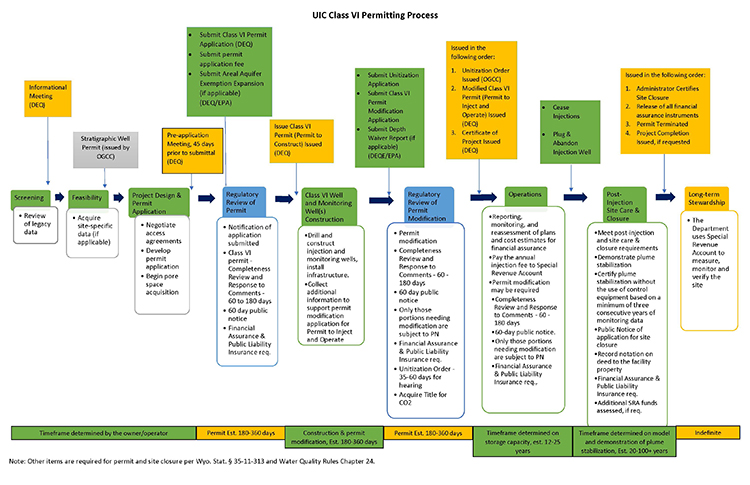
The following is the permitting, operating and closure process for a Class VI well in Wyoming:
Section 1421 of the Safe Drinking Water Act (SOWA) requires the US EPA to develop UIC program requirements that protect underground sources of drinking water. Primary enforcement authority, often called primacy, refers to state, territory or tribal responsibilities associated with implementing US EPA approved UIC programs. Primacy programs are established under Section 1422 and 1425 of the SDWA. Wyoming received primacy over Class I through V in 1983. The Wyoming Department of Environmental Quality received primacy over Class VI wells on September 3. 2020. Wyoming is one of two states to have received primacy for implementing the Class VI program; the other is North Dakota.
Wyoming’s primacy documents can be found here:
https://www.federalregister.gov/documents/2020/10/09/2020-20544/wyoming-underground-injection- control-program -class-vi-primacy