








TMDL
States are required to develop total maximum daily load (TMDL) pollutant levels for waterways that are not adequately meeting federal Clean Water Act water quality standards.
What is a Total Maximum Daily Load (TMDL)?
TMDLs are a requirement of Section 303(d) of the Clean Water Act (CWA). According to the CWA, each state must develop TMDLs for all the waters identified on their Section 303(d) list of impaired waters. A TMDL is a calculation of the maximum amount of a pollutant that a waterbody can receive while still meeting water quality standards. An overview of TMDLs is provided on EPA’s website. Simply, a TMDL is a plan to achieve water quality standards for impaired waterbodies.
In general, states are responsible for developing TMDLs and submitting them to EPA for approval. Even if third parties assist in the development of the TMDL or its supporting analysis, such TMDLs must still be submitted to EPA by the states.
Under the CWA, the EPA reviews and either approves or disapproves the TMDL. If EPA disapproves a state TMDL, EPA must develop a replacement TMDL.
The Process
The TMDL Program coordinates with several other DEQ programs including the Monitoring, Assessment, Permitting, and Nonpoint Source Programs to accomplish water quality restoration goals in Wyoming. TMDLs are one step in the “water quality restoration pipeline”.

The process begins when a waterbody is placed on the 303(d) list due to an exceedance of one or more water quality standards. Once an impaired water is placed on the 303(d) list, water quality restoration planning begins.
The TMDL is the planning step in the process where sources of pollution to streams, rivers, and lakes within Wyoming are identified and it is determined by how much pollution those waters can sustain and still fully support beneficial uses.
TMDLs are not self-implementing. Rather, TMDLs are implemented through existing regulatory and non-regulatory drivers. Point sources of pollution are addressed through the Wyoming Pollution Discharge and Elimination System (WYPDES) permit program. Federal regulations require that discharge permit limits be consistent with the assumptions and requirements of any available wasteload allocation in approved TMDLs (40 CFR 122.44(d)(1)(vii)(B)). Non-point sources load reduction actions are implemented through a wide variety of programs at the state, local and federal level. These programs may be regulatory, non-regulatory or incentive-based (e.g., a cost-share program). Wyoming works closely with conservation districts and watershed stakeholders through voluntary actions, often with support from Wyoming’s Nonpoint Source Program using Clean Water Act Section 319 and 205(j) grant funds for projects aimed at reducing the nonpoint source pollution.
Follow-up monitoring to examine water quality trends over time, and BMP effectiveness monitoring to evaluate the efficacy of implemented best management practices, are important components of the process. Achieving the ultimate goal of meeting the applicable water quality standards often takes many years and follow-up monitoring data can both facilitate and inform adaptive management actions, and track progress over time. Much of the follow-up monitoring in Wyoming is conducted by watershed stakeholders with technical support provided by WDEQ.
| NAME/EMAIL ADDRESS | PROGRAM | PHONE |
| David Waterstreet, Program Manager | Watershed Program | 307-777-6709 |
| Clean Water Act (CWA) Section 401 Certification and Turbidity Waivers | ||
| James Tarzon (Cheyenne) | CWA Section 401 Certification, Turbidity Waivers | 307-777-6701 |
| Data Quality Assurance and Quality Control (QA/QC) | ||
| Jennifer Pollard (Cheyenne) | Data QA/QC | 307-777-6372 |
| Surface Water Monitoring Program | ||
| Jeremy Zumberge, Program Supervisor (Sheridan) | Surface Water Monitoring Program | 307-675-5638 |
| Tavis Eddy (Lander) | Surface Water Monitoring Program | 307-335-6957 |
| Grant Wichman (Cheyenne) | Surface Water Monitoring Program | 307-777-6353 |
| Jason Martineau (Sheridan) | Surface Water Monitoring Program | 307-675-5632 |
| James Tarzon (Cheyenne) | Surface Water Monitoring Program | 307-777-6701 |
| Daniel Bryant (Sheridan) | Surface Water Monitoring Program | 307-675-5637 |
| Michael Wachtendonk (Lander) | Surface Water Monitoring Program | 307-335-6751 |
| Surface Water Quality Standards | ||
| Eric Hargett, Program Supervisor (Cheyenne) | Surface Water Quality Standards | 307-777-7079 |
| Rachel Eyres (Cheyenne) | Surface Water Quality -Standards, Harmful Cyanobacterial Blooms | 307-777-2073 |
| Jackson Akin (Cheyenne) | Surface Water Quality Standards, National Environmental Policy Act (NEPA) | 307-777-7050 |
| Total Maximum Daily Load (TMDL)/Assessment/ Nonpoint Source Pollution/Program | ||
| Ron Steg, Program Supervisor (Lander) | Total Maximum Daily Load (TMDL) | 307-335-6980 |
| Joanna Harter (Lander) | Total Maximum Daily Load (TMDL) | 307-335-6965 |
| Race Stryker (Cheyenne) | Nonpoint Source Program Coordinator | 307-777-6755 |
| Water Quality Lab | ||
| Steve Vien, Lab Supervisor (Cheyenne) | Water Quality Lab | 307-777-7654 |
| Rex Bagley (Cheyenne) | Water Quality Lab | 307-777-7151 |
| Amaryllis Briggs (Cheyenne) | Water Quality Lab | 307-777-6783 |
| Alexis Lester(Cheyenne) | Water Quality Lab | 307-777-3770 |
This page is under development.
This page contains links to all of the completed and approved TMDL documents. Links to TMDLs for individual waterbody segments are provided in the interactive TMDL and Assessment Map.
If the download box is not working below, please click here.
This page is under development.
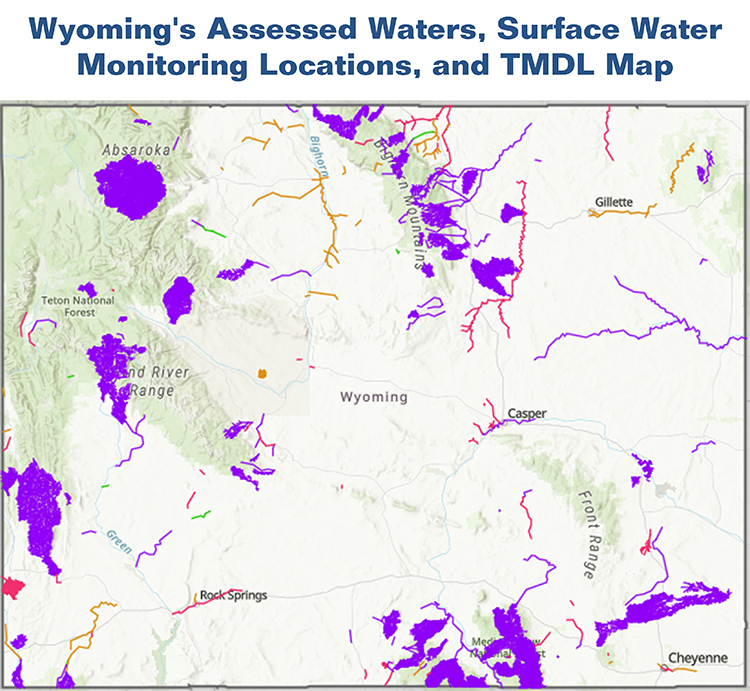
Click on the map below to access Wyoming’s Assessed Waters, Surface Water Monitoring Locations, and TMDL Map. This web map provides access to:
- summary information about each of Wyoming’s lakes and streams that have been assessed against Wyoming’s water quality standards,
- monitoring locations and links to data request portals,
- and watersheds for which TMDLs have been completed.